
'%20fill='%23fff'/%3e%3c/clipPath%3e%3c/defs%3e%3cg%20id='logo_s'%20transform='translate(3331%2011131)'%20clip-path='url(%23clip-path)'%3e%3ccircle%20id='椭圆_3510'%20data-name='椭圆%203510'%20cx='15'%20cy='15'%20r='15'%20transform='translate(-3330%20-11130)'%20fill='%23ffffff'%20opacity='0'/%3e%3cpath%20id='联合_790'%20data-name='联合%20790'%20d='M17,22.938H3.615a3.694,3.694,0,0,1-2.759-.895A3.625,3.625,0,0,1,0,19.454V3.489C.031,1.194,1.2.087,3.689.005H13.43L13.492,0V3.98a3,3,0,0,0,3,3h4.193V19.454c-.025,1.589-.662,3.485-3.554,3.485ZM5.8,16.588a.88.88,0,0,0,.879.879H14.1a.879.879,0,0,0,0-1.759H6.681A.88.88,0,0,0,5.8,16.588Zm0-3.836a.88.88,0,0,0,.879.879H14.1a.88.88,0,0,0,0-1.759H6.681A.881.881,0,0,0,5.8,12.752Zm0-3.837a.88.88,0,0,0,.879.879h4.783a.879.879,0,1,0,0-1.759H6.681A.88.88,0,0,0,5.8,8.915ZM17.031,5.5a2,2,0,0,1-2-2V.365a1.9,1.9,0,0,1,.3.235c.564.547,2.329,2.146,3.5,3.2l.068.061.886.8a2.8,2.8,0,0,1,.636.834Z'%20transform='translate(-3325.342%20-11126.47)'%20fill='%23ffffff'/%3e%3c/g%3e%3c/svg%3e)


 Where the Corolla Cross Fits
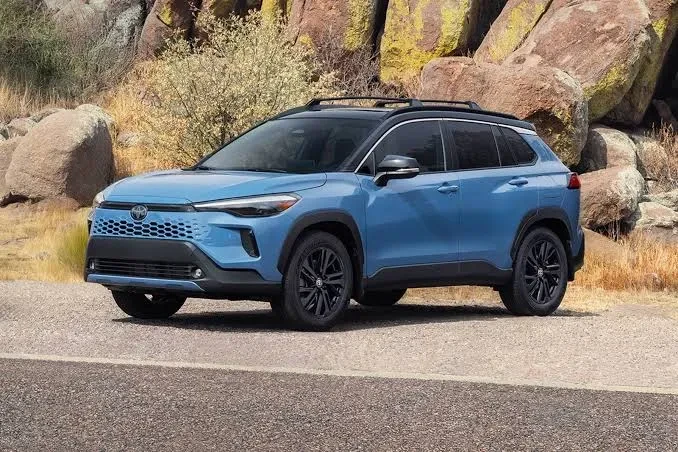 Where the Corolla Cross Fits
The Corolla Cross is for drivers who want compact dimensions for easy parking, but need more utility than a sedan. It is smaller than a traditional compact SUV, yet taller and more practical than a Corolla sedan. That makes it appealing for commuting, errands, school runs, and weekend errands.
The trade-off is interior space. The rear seat is tighter than some shoppers expect from an SUV. Legroom is around 32 inches, which is fine for short trips but can feel cramped for taller adults or growing teenagers. If you regularly carry passengers in the back, test that space before you fall in love with the exterior.
Cargo volume behind the rear seats is roughly 22 cubic feet. That is useful for groceries, luggage, or a stroller, but it is not a substitute for a larger SUV. Measure your actual gear before assuming it will fit.
The Trim Ladder: L, LE, XLE, and Hybrid S, SE, XSE
Trim choice is where small SUVs get expensive fast. A base model looks affordable online. A top trim feels luxurious in the showroom. The smart money usually lands somewhere in the middle—but only after you know which features you will actually use.
L Trim: The Budget-Conscious Starting Point
The L trim is for buyers who want Toyota basics and a lower payment. It includes the core safety suite and essential infotainment, but the cabin uses more hard plastics and fewer comfort features.
If your commute is predictable and you do not care about heated seats or premium audio, the L can be a rational choice. But sit in it with your daily items—bag, coffee, phone, child seat—and ask whether the interior feels acceptable for the next five years. If you immediately wish for a nicer display or softer surfaces, price the next trim before settling.
LE Trim: The Balanced Middle
The LE adds more convenience features and a more livable interior. It is often the sweet spot for shoppers who want a better feature set without jumping to the top of the range.
If you are shopping used, a 2023 Corolla Cross LE can offer strong value if it has the features you want and a clean history. Compare its price against a new LE and factor in warranty, financing, and condition.
XLE Trim: Comfort at a Cost
The XLE adds the comforts many buyers want: upgraded upholstery, larger touchscreen, heated seats, power liftgate, and more. It makes daily driving more pleasant.
The risk is price creep. A fully loaded XLE can push into the low-to-mid $30,000 range. At that point, you are no longer comparing it only to a Corolla sedan—you are comparing it to larger SUVs, better-equipped rivals, or a hybrid version of the same vehicle.
If you are considering the XLE, list the features you will use weekly. Heated seats in a cold climate? Worth it. A premium audio system you barely notice? Not worth stretching your budget.
Hybrid Trims: S, SE, XSE
Hybrid models often use a sportier trim naming structure: S, SE, and XSE. They offer better fuel economy and a more responsive driving feel, but at a higher upfront cost. The hybrid is most compelling for high-mileage commuters who will actually see the savings at the pump.
Gas vs. Hybrid: The Math You Need to Do
The gas Corolla Cross uses a 2.0-liter four-cylinder engine with 169 horsepower. It is adequate for city and suburban driving, but it is not quick. With all-wheel drive, 0–60 mph takes around 9.3 seconds. That is fine for daily commuting, but if you regularly merge onto fast highways, climb steep grades, or carry a full load, test it under those conditions.
The hybrid delivers significantly better fuel economy—around 42 mpg combined. That is a real advantage for commuters who drive many miles. The catch is the price gap, often $4,000 to $5,000 more than the gas model.
How to decide:
- Estimate your annual mileage.
- Check your local fuel prices.
- Calculate the annual fuel cost for both gas and hybrid.
- Multiply the difference by the number of years you plan to own the vehicle.
- Compare that total savings against the hybrid’s higher purchase price.
If you drive 15,000 miles a year or more, the hybrid often pays back within a reasonable ownership window. If you drive fewer than 8,000 miles a year, the gas model may be the more economical choice.
Comfort, Tech, and Safety
Toyota includes its Safety Sense 3.0 suite as standard, which takes pressure off climbing trims just to get basic driver assistance. That is a genuine value point.
Available features on higher trims include: A 12.3-inch digital gauge cluster A 10.5-inch touchscreen infotainment system JBL Premium Audio with nine speakers A Cold Weather Package with heated seats and heated steering wheel Wireless charging and multiple USB ports
These features can make the Corolla Cross feel more upscale, but they are often locked to higher trims or packages. Price them honestly. If you live in a cold climate, heated seats and a heated steering wheel are not luxuries—they are daily quality-of-life improvements. If you live in a mild climate, they may be unnecessary.
How It Compares With Rivals
The small SUV segment is brutally competitive. The Corolla Cross has strengths, but so do its rivals.
| Rival | Potential Advantage |
|---|---|
| Honda HR-V | Better rear-seat packaging and interior versatility |
| Subaru Crosstrek | Standard all-wheel drive and rugged appeal |
| Hyundai Kona | More features for the money and bold styling |
| Kia Seltos | Strong value and available turbo engine |
| Mazda CX-30 | Premium interior feel and engaging driving dynamics |
| Nissan Rogue Sport / Qashqai | Comfortable ride and practical cabin |
| Volkswagen Taos | Efficient turbo engine and spacious rear seat |
| Chevrolet Trax | Low starting price and surprising feature content |
| Ford Bronco Sport | Off-road capability and distinctive design |
| Buick Envista | Upscale styling at a value price |
Use these rivals to test your assumptions. If the Corolla Cross L feels too plain, sit in a Kia Seltos or Hyundai Kona at the same price. If rear-seat space matters, bring your passengers and compare the HR-V and Taos. If you want a more premium feel, drive the Mazda CX-30.
The goal is not to find a universal winner. It is to find the vehicle that fits your priorities.
New vs. Used: Where the Value Lies
A used Corolla Cross can be a strong value, especially if depreciation has done its work. Search for 2022 and 2023 models, including the LE and XLE trims. Compare their prices against new models with similar equipment.
What to check on a used Corolla Cross: Mileage and service history Accident reports and title status Tire condition and remaining tread Warranty coverage and transferability Whether the specific trim includes the features you want Hybrid battery health if considering a used hybrid
A 2023 Corolla Cross LE with low miles and a clean history may offer better value than a new base model. But a rough example with poor maintenance can erase the savings quickly.
A Practical Buying Plan
Follow these steps to avoid overpaying or choosing the wrong configuration.
- Drive the gas model first. Use a route with highway merging, stop-and-go traffic, and a hill if possible.
- Drive the hybrid next. Compare responsiveness, fuel economy, and the price difference.
- Sit in the L, LE, and XLE. Identify which features genuinely improve your daily routine.
- Test the rear seat. Bring adults or install a child seat. Do not assume it will be comfortable.
- Measure cargo. Use the items you actually carry—strollers, sports gear, luggage.
- Get an out-the-door price in writing. Include destination fees, taxes, dealer add-ons, and documentation fees.
- Compare at least three rivals. Honda, Subaru, Hyundai, Kia, and Mazda all offer compelling alternatives.
- Check financing options. Compare Toyota Financial Services against your bank or credit union.
- Value your trade separately. Use Kelley Blue Book or CarMax to establish a baseline before negotiating.
- Do not rush. If the numbers are unclear, leave and review them at home.
Best-Fit Recommendations
Choose the L trim if: You want the lowest practical entry point, accept a plainer cabin, and drive mostly routine routes.
Choose the LE trim if: You want a better balance of features, comfort, and value without jumping to the top.
Choose the XLE if: The comfort features solve real daily annoyances, and the final price stays comfortably below larger SUV alternatives.
Choose the hybrid if: You drive enough miles to make the fuel savings meaningful, and you prefer stronger everyday efficiency.
Consider a used 2023 model if: Depreciation has created a better value, and the condition, mileage, and warranty check out.
Final Verdict
The 2026 Toyota Corolla Cross is a sensible, durable, and practical small SUV. It is not the roomiest, the quickest, or the most luxurious in its class. But it does many things well, and Toyota’s reliability and resale value are real advantages.
The key is discipline. Test the exact trim and powertrain you are considering. Run the hybrid math with your own mileage. Compare at least three rivals. Set a maximum out-the-door price before you visit the dealer. If you do that, the Corolla Cross can be an excellent choice. If you skip those steps, you may end up paying top-trim money for a vehicle that does not fit your life.
Toyota gives the Corolla Cross a strong foundation. Your job is to make sure the version in your driveway is the one that truly works for you.


