
'%20fill='%23fff'/%3e%3c/clipPath%3e%3c/defs%3e%3cg%20id='logo_s'%20transform='translate(3331%2011131)'%20clip-path='url(%23clip-path)'%3e%3ccircle%20id='椭圆_3510'%20data-name='椭圆%203510'%20cx='15'%20cy='15'%20r='15'%20transform='translate(-3330%20-11130)'%20fill='%23ffffff'%20opacity='0'/%3e%3cpath%20id='联合_790'%20data-name='联合%20790'%20d='M17,22.938H3.615a3.694,3.694,0,0,1-2.759-.895A3.625,3.625,0,0,1,0,19.454V3.489C.031,1.194,1.2.087,3.689.005H13.43L13.492,0V3.98a3,3,0,0,0,3,3h4.193V19.454c-.025,1.589-.662,3.485-3.554,3.485ZM5.8,16.588a.88.88,0,0,0,.879.879H14.1a.879.879,0,0,0,0-1.759H6.681A.88.88,0,0,0,5.8,16.588Zm0-3.836a.88.88,0,0,0,.879.879H14.1a.88.88,0,0,0,0-1.759H6.681A.881.881,0,0,0,5.8,12.752Zm0-3.837a.88.88,0,0,0,.879.879h4.783a.879.879,0,1,0,0-1.759H6.681A.88.88,0,0,0,5.8,8.915ZM17.031,5.5a2,2,0,0,1-2-2V.365a1.9,1.9,0,0,1,.3.235c.564.547,2.329,2.146,3.5,3.2l.068.061.886.8a2.8,2.8,0,0,1,.636.834Z'%20transform='translate(-3325.342%20-11126.47)'%20fill='%23ffffff'/%3e%3c/g%3e%3c/svg%3e)


 Why Certifications Are Non-Negotiable Offshore
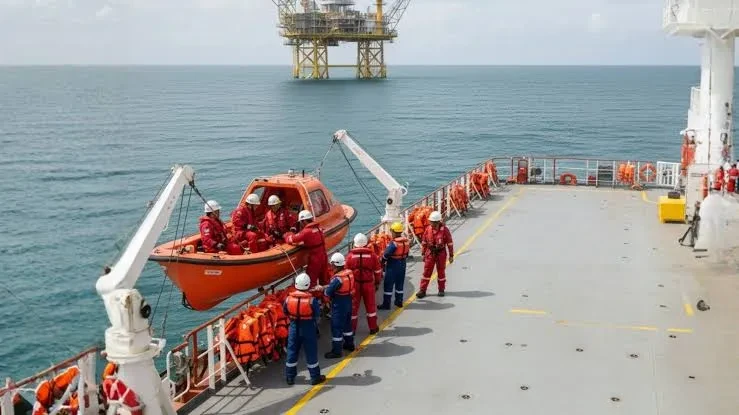 Why Certifications Are Non-Negotiable Offshore
Offshore installations are high-hazard environments. A single mistake—an unsecured load, a gas leak, a failed helicopter ditching—can be catastrophic. Regulators, insurers, and drilling contractors manage that risk by requiring every worker to prove they can handle emergencies before they ever board a flight.
Certifications serve three purposes:
Liability protection. Operators and drilling contractors cannot legally place untrained personnel on an offshore asset. Accredited training transfers a documented level of competence, which shields employers from regulatory penalties and lawsuits.
Operational readiness. Workers must know how to don survival suits, escape a submerged helicopter, respond to hydrogen sulfide alarms, and fight platform fires. Training ensures these responses become instinctive.
Screening. In high-volume hiring pools, verified credentials separate serious applicants from uncertified beginners. A candidate with a valid BOSIET and TWIC card moves to the front of the queue immediately.
The Core Certifications You Actually Need
The baseline requirement for virtually all offshore roles is the OPITO BOSIET with CA-EBS, paired with a valid offshore medical. From there, additional certifications depend on your target role, region, and employer.
| Certification | What It Covers | Typical Cost | Validity |
|---|---|---|---|
| OPITO BOSIET with CA-EBS | Sea survival, fire safety, first aid, self-rescue, compressed air emergency breathing | $1,000–$1,600 | 4 years |
| HUET (Helicopter Underwater Escape Training) | Escape from a submerged, inverted helicopter simulator; often bundled into BOSIET | $300–$600 standalone | 4 years |
| OEUK / OGUK Offshore Medical & Fit-to-Train | Cardiovascular, hearing, vision, lung capacity, BMI, and fitness step test | $200–$325 | 2 years |
| H2S Alive / Hydrogen Sulfide Awareness | Detection, protection, and response to toxic sour gas exposure | $150–$250 | 1–3 years |
| IWCF or IADC WellSharp | Well control for drilling personnel — kick detection, shut-in procedures, blowout prevention | $1,200–$2,500 | 2 years |
| TWIC (Transportation Worker Identification Credential) | U.S. port and vessel access clearance; required in the Gulf of Mexico | $125.25 | 5 years |
| Crane Operator Stage 2/3 | Rig crane operations and load handling | $1,500–$3,000 | 2–3 years |
Total baseline investment: Expect to spend $1,325–$1,900 for the minimum credentials needed to apply for an entry-level offshore job. Specialized technical certifications add significantly to that figure.
Understanding the Medical Clearance
The offshore medical is where many candidates fail—not because they lack training, but because their health doesn't meet the standard. The OEUK (formerly OGUK) medical exam evaluates:
Body mass index (BMI) Blood pressure and cardiac health Lung capacity and respiratory function Hearing and vision A fitness step test (the Chester Step test is commonly used)
A failed medical means your BOSIET certificate is essentially unusable for offshore deployment until you meet the health benchmarks. This is not a formality. Workers must be capable of climbing stairs, carrying loads, and functioning in extreme conditions while wearing survival equipment.
Practical advice: Book your medical before paying for expensive training. There is no point spending $1,500 on BOSIET if a medical disqualification is likely.
How and Where to Enroll
Only train through OPITO-approved or IADC-accredited facilities. Certificates from unaccredited providers are frequently rejected by operators, which means you'll pay twice.
Major training hubs include:
Houston and Lafayette (U.S.) — Gulf of Mexico operators Aberdeen (UK) — North Sea operations Dubai and Abu Dhabi (UAE) — Middle East offshore fields Singapore and Perth (Australia) — Asia-Pacific operations
These centers maintain accredited simulation tanks, fire grounds, and helicopter ditching simulators that smaller providers cannot replicate.
Before you enroll: Confirm the compliance requirements of your target region. North Sea operators may require OEUK medicals and specific Norwegian or UK modules, while Gulf of Mexico work demands TWIC and U.S. Coast Guard–recognized training.
Employer sponsorship: Large drilling contractors such as Transocean, Valaris, Noble, and Shelf Drilling often sponsor specialized technical modules for new hires. However, nearly all expect candidates to arrive with baseline BOSIET and TWIC already in hand.
Financial Reality: Certification Costs vs. Offshore Day Rates
Offshore work pays well because it is demanding, rotational, and remote. Rotations typically run 14 days on / 14 days off or 28/28, meaning you work roughly 182 days per year while earning a full annual income.
| Role | Certifications Required | Upfront Investment | Average Day Rate | Annualized (≈182 days) |
|---|---|---|---|---|
| Greenhand / Roustabout | BOSIET + Medical + TWIC | $1,325–$1,900 | $220–$310 | $40,000–$57,500 |
| Roughneck / Floorhand | BOSIET + WellSharp Intro | $2,500–$3,500 | $330–$490 | $60,000–$90,000 |
| Rig Crane Operator | BOSIET + Crane Stage 2/3 | $3,000–$5,000 | $450–$650 | $82,000–$118,000 |
| Driller / Toolpusher | BOSIET + IWCF/WellSharp L3/4 | $4,500–$7,000 | $550–$900+ | $100,000–$160,000+ |
The math is straightforward: a roustabout can recover the full cost of entry-level certification within the first two to three hitches. Career progression multiplies that return.
Hidden Costs and Ongoing Obligations
The upfront price tag is only part of the picture. Offshore workers face recurring costs that catch unprepared candidates off guard.
Refresher training. BOSIET certificates expire after four years. Before expiration, you must complete a FOET (Further Offshore Emergency Training) refresher, costing $800–$1,100. If your BOSIET lapses entirely, you must retake the full three-day course at full price.
Travel and staging costs. Unless employed under a full-time contract, workers typically pay their own travel to the helicopter staging port. In remote regions, this can add hundreds of dollars per rotation.
Unpaid off-hitch weeks. Contract workers receive no pay during off-hitch periods. Budgeting for 26 weeks of no income per year requires discipline.
Personal protective equipment. While employers typically provide PPE, some contract roles require workers to supply their own boots, coveralls, or specialty gear.
Physical Demands and Safety Risks
Offshore work is physically punishing. Roustabouts and roughnecks work 12-hour shifts in extreme weather—heavy seas, freezing winds, or blistering heat. Decks are slippery, loads swing unpredictably, and noise levels are high enough to require hearing protection.
Key hazards include: Musculoskeletal injuries from lifting and moving heavy equipment Struck-by incidents from swinging crane loads Chemical and gas exposure, particularly H2S Falls from height or overboard Fatigue-related errors during long rotations
Strict PPE compliance and situational awareness are not optional—they are the difference between a career and a casualty.
Step-by-Step: How to Start Your Offshore Career
1. Get your medical first. Book an OEUK/OGUK offshore medical and Fit-to-Train assessment. Confirm you meet the physical standards before investing further.
2. Apply for TWIC. If you plan to work in U.S. waters, begin the TWIC application process early. It can take several weeks.
3. Book accredited BOSIET training. Choose an OPITO-approved center in your region. Confirm the course includes CA-EBS and HUET modules.
4. Add specialized certifications. Depending on your target role, pursue WellSharp, crane operator, or H2S Alive training.
5. Build a credential file. Keep digital and physical copies of every certificate, medical clearance, and training record. Operators will ask for them repeatedly.
6. Apply strategically. Target drilling contractors, service companies, and staffing agencies that hire entry-level roustabouts. Highlight your certifications prominently on your CV.
7. Track expiration dates. Set reminders 6–9 months before your BOSIET or medical expires so you can schedule refreshers without downtime.
Common Mistakes to Avoid
Training before the medical. Don't spend $1,500 on BOSIET if you haven't confirmed you'll pass the medical.
Using unaccredited providers. Cheap courses from unrecognized trainers are often rejected by operators, forcing you to pay twice.
Letting certificates lapse. A lapsed BOSIET means retaking the full course. Refreshers are far cheaper—schedule them on time.
Ignoring regional requirements. North Sea, Gulf of Mexico, and Middle East operators have different compliance demands. Train for your target market.
Underestimating physical demands. Offshore work is not for everyone. Be honest about your fitness and tolerance for harsh conditions.
Assuming immediate employment. Certification makes you eligible, not guaranteed. Expect competition and be prepared to apply broadly.
Final Thoughts
An offshore oil rig career offers exceptional earning potential, structured rotations, and genuine advancement for workers willing to invest in themselves. But the entry price is real: accredited training, medical fitness, and ongoing refresher obligations. Done correctly, the return on investment is excellent—often recovered within the first few hitches and multiplied many times over as you progress from roustabout to driller.
The path starts with two things: a valid offshore medical and an OPITO BOSIET certificate. Everything else builds from there. Get those in order, keep your credentials current, and you'll be positioned to compete for one of the most financially rewarding careers in the industrial sector.


