
'%20fill='%23fff'/%3e%3c/clipPath%3e%3c/defs%3e%3cg%20id='logo_s'%20transform='translate(3331%2011131)'%20clip-path='url(%23clip-path)'%3e%3ccircle%20id='椭圆_3510'%20data-name='椭圆%203510'%20cx='15'%20cy='15'%20r='15'%20transform='translate(-3330%20-11130)'%20fill='%23ffffff'%20opacity='0'/%3e%3cpath%20id='联合_790'%20data-name='联合%20790'%20d='M17,22.938H3.615a3.694,3.694,0,0,1-2.759-.895A3.625,3.625,0,0,1,0,19.454V3.489C.031,1.194,1.2.087,3.689.005H13.43L13.492,0V3.98a3,3,0,0,0,3,3h4.193V19.454c-.025,1.589-.662,3.485-3.554,3.485ZM5.8,16.588a.88.88,0,0,0,.879.879H14.1a.879.879,0,0,0,0-1.759H6.681A.88.88,0,0,0,5.8,16.588Zm0-3.836a.88.88,0,0,0,.879.879H14.1a.88.88,0,0,0,0-1.759H6.681A.881.881,0,0,0,5.8,12.752Zm0-3.837a.88.88,0,0,0,.879.879h4.783a.879.879,0,1,0,0-1.759H6.681A.88.88,0,0,0,5.8,8.915ZM17.031,5.5a2,2,0,0,1-2-2V.365a1.9,1.9,0,0,1,.3.235c.564.547,2.329,2.146,3.5,3.2l.068.061.886.8a2.8,2.8,0,0,1,.636.834Z'%20transform='translate(-3325.342%20-11126.47)'%20fill='%23ffffff'/%3e%3c/g%3e%3c/svg%3e)


 The Technological Milestone: Why is Fractional CO2 Laser the "Gold Standard"?
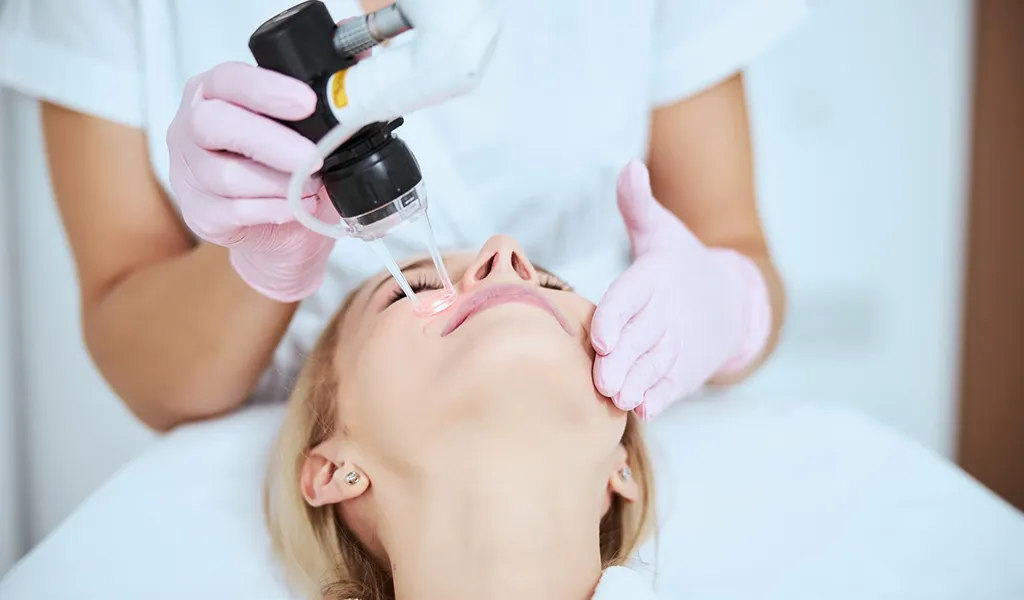
The advent of fractional laser technology was a paradigm shift. Unlike older, fully ablative lasers that vaporized the entire skin surface, fractional CO2 revolutionized the approach, making profound results accessible with a safer, more manageable recovery profile.
The Genius of Fractionated Micro-Treatment
- The Science of Microscopic Treatment Zones (MTZs): The laser delivers thousands of microscopic, high-energy beams that create precise columns of thermal injury—coagulating tissue and vaporizing water in the skin. The critical innovation is that these MTZs are surrounded by areas of completely untouched, healthy skin. This "fractionated" pattern acts as a biological trigger, launching a powerful wound-healing response where the intact skin cells rapidly migrate to repair the treated columns, generating fresh, new collagen, elastin, and skin tissue. It's not just surfacing; it's internally restructuring the skin's foundation.
- Unparalleled Efficacy for Moderate to Severe Concerns: While many lasers address superficial texture, fractional CO2 is uniquely capable of tackling deep static wrinkles (especially around the mouth and eyes), significant sun damage, acne scars, and overall skin laxity. It effectively treats both the epidermal texture and the dermal collagen matrix in a single, powerful session.
- The Customizability of Modern Platforms: Today's advanced fractional CO2 systems (like Fraxel Repair, Lumenis UltraPulse) allow practitioners to precisely adjust energy, density (spacing of MTZs), and pulse duration. This enables a truly tailored treatment—from a lighter "rejuvenation" pass to a more aggressive "resurfacing" protocol—optimizing outcomes for individual skin types and concerns.
Clinical Validation and Enduring Legacy
Decades of clinical use and research have solidified its position. It is consistently cited in dermatology literature as the most effective non-surgical modality for significant wrinkle reduction and skin remodeling. Patient satisfaction is high due to the dramatic, long-lasting nature of the results.
Testimonial from a Patient (6 Months Post-Treatment): "I had spent years trying creams and milder lasers for my sun spots and the deep lines on my upper lip, with only modest improvement. My dermatologist recommended a single, aggressive fractional CO2 treatment. The first week was intense—like a bad sunburn—but I followed the aftercare religiously. By month three, the transformation was undeniable. My skin wasn't just smoother; it was tighter, more even, and had a healthy glow I hadn't seen since my 30s. The lines around my mouth are virtually gone. It was a significant investment in recovery time and cost, but for the level of correction I wanted, it was unequivocally worth it," shares Margaret L., 58, a retired teacher from San Diego. This underlines the procedure's value: a well-performed fractional CO2 treatment can deliver multi-year benefits, setting it apart from maintenance-oriented procedures.
Demystifying the Treatment Spectrum: What Level is Right For You?
Not all fractional CO2 treatments are created equal. The intensity and results exist on a spectrum, defined by the treatment parameters set by your provider.
Light/Recovery Fractional CO2 (Often called "Fraxel" or "Mini-CO2")
- The Proposition: A lighter treatment with higher density but lower energy per microscopic column. Focuses on superficial texture improvement, mild sun damage, and pore refinement.
- Key Indicators: Minimal downtime (2-4 days of redness and peeling, like a sunburn). Often requires a series of 2-3 treatments spaced a month apart for optimal results. Minimal social disruption.
- Best For: Those with mild to moderate photodamage seeking a "refresh," or as maintenance after a more aggressive treatment.
Aggressive/Full Resurfacing Fractional CO2
- The Proposition: The definitive, single-session treatment for significant wrinkles, deep acne scarring, and substantial sun damage. Uses higher energy and appropriate density to drive collagen remodeling deep into the dermis.
- Key Indicators: Significant but predictable downtime. Typically involves 7-14 days of more intense recovery with noticeable redness, swelling, and crusting before revealing the new skin underneath. Delivers the most dramatic, long-lasting results.
- Best For: Patients with pronounced signs of aging or scarring who are willing to undergo a more involved recovery for transformative outcomes.
The Heart of the Decision: Fractional CO2 vs. Other Modalities
Understanding where this laser fits in the broader aesthetic toolbox is crucial.
- Vs. Non-Ablative & Fractional Non-Ablative Lasers (e.g., Fraxel Dual, Clear + Brilliant): These lasers leave the epidermis intact, heating the dermis below. They have minimal to no downtime but require multiple sessions and offer more modest, gradual improvement. They are for maintenance and mild concerns, not for significant wrinkle eradication.
- Vs. Fully Ablative CO2 (Old School): The traditional CO2 laser treated 100% of the skin surface. While extremely effective, it carried very high risks of scarring, pigmentation changes, and prolonged (months) recovery. Fractional CO2 provides a far safer risk profile with comparable efficacy for most concerns.
Vs. Radiofrequency Microneedling (e.g., Morpheus8): This technology uses needles to deliver radiofrequency energy deep into the skin. Excellent for skin tightening and volumetric improvement with less surface disruption. However, for treating surface texture, deep etched lines, and severe sun damage*, fractional CO2 is generally considered more powerful.
Undergoing Fractional CO2 in 2024: The Informed Patient's Roadmap
This is a medical procedure, not a spa treatment. Success hinges on expert execution and meticulous aftercare.
Why is the "Who" More Important Than the "What"?
- Experience is Paramount: The skill of the operator in choosing settings and managing the endpoint of the treatment is the single greatest factor in your outcome and safety.
Realistic Expectations are Key: A thorough consultation should outline exactly what the laser can and cannot do, and what the recovery will truly* look like day-by-day.
Mandatory Checklist for Considering Fractional CO2 Laser
1. Choose a Board-Certified Expert: Seek a dermatologist or plastic surgeon with extensive, specific experience in performing aggressive fractional CO2 laser resurfacing. Review their before-and-after photo gallery of patients with similar skin tones and concerns.
2. The Consultation is Non-Negotiable: This must include a full medical history, discussion of all medications/supplements (especially Accutane), and a skin assessment. Your provider must evaluate your Fitzpatrick skin type and any history of keloids or herpes simplex (cold sores) to mitigate risks of pigmentation changes or outbreaks.
3. Pre-Treatment Preparation is Critical: You will likely be prescribed a pre-treatment skincare regimen for 4-6 weeks (e.g., retinoids, hydroquinone, growth factors) to prime the skin, optimize results, and reduce complication risks. Antiviral medication is standard to prevent a herpes outbreak.
4. Plan Your Downtime Meticulously: For an aggressive treatment, you will need at least 7-10 days where you can be at home, not in public. Arrange for help, prepare meals in advance, and have all recommended post-care products (gentle cleanser, thick ointment, sterile dressings) ready.
5. Commit to the Post-Procedure Protocol Religiously: The first 72 hours are about cooling, gentle cleansing, and constant moisturizing/occlusion. Strict sun avoidance and vigilant sunscreen use (SPF 30+, physical blocker) for months after treatment is absolutely mandatory to protect the new skin and prevent hyperpigmentation.
Conclusion: More Than a Treatment, a Definitive Investment in Your Skin's Future
Fractional CO2 laser resurfacing stands as one of the most significant technological triumphs in aesthetic medicine. It is a procedure that demands respect—for its power, its required recovery, and its unparalleled ability to address the structural deficits of aged skin.
If you are considering this path, you are looking at the apex of non-surgical skin renewal. You are not simply booking an appointment; you are initiating a controlled healing process that will rebuild your skin from the inside out.
Invest your time in selecting the right physician, not the right deal. Embrace the necessity of the pre- and post-care rituals. In doing so, you are not just undergoing a laser treatment. You are making a strategic, transformative investment in your skin's architecture—a decision that leverages precise science to deliver a result that is not merely a change, but a profound restoration. A choice that, for the right candidate with the right preparation, remains the definitive answer for turning back time.


